 The Ethel Walker School
Curriculum
Walker’s curriculum combines the traditional areas of liberal arts studies — science, math, history, English, world languages, and the arts — with electives that are relevant to the world today.
The faculty, including both exciting new educators and well-tenured teachers, animate the coursework with discussion-based exploration and project-based learning.
Explore Our Curriculum
Use the boxes below to filter your search results or view our full Curriculum Guide here.
Students focus on study skills and executive function strategies, such as sustained attention, task initiation, working memory, planning, and organization. Students work on skills-building activities from the SMARTS Executive Function Curriculum developed by the Research Institute for Learning and Development.
7th Grade Wellness Seminar meets twice a week for a semester. This seminar is a discussion-based class where students focus on emotional well-being and social emotional learning with a particular emphasis on relationship skills. With identity as their primary focus during this period of development, students are in search of solid and meaningful relationships. Each class with a brief meditation and a check-in. Students are given writing or discussion prompts to help begin conversations related to their developing social awareness and the skills involved in forming and maintaining healthy relationships.
The Middle School Dance program concentrates on the development of technical skills, and the appreciation of the art form.
Offered Fall 2026
This ceramics class will provide an introduction of sculpture techniques, the science of glazing, and wheel skills, and students will be encouraged to experiment at all times. In addition to developing technique, students will design their own multi-part construction based on exploration of pottery around the world. Each student will be expected to produce work that portrays her creative powers and technical abilities.
Offered Fall 2026
This course is designed to give students an overview of theatre technique, storytelling, playwriting, improvisation, and design. Students will study several theatre techniques and styles to build a foundation in the performing arts. The study of theatre through class activities and play projects will be a focal point of the course.
Offered Fall 2026
MS Music includes singing and choral activities, rhythm training, music theory, musical theater/theater exercises, sight singing, and audition preparation. There is an emphasis on listening and skill development, as well as music appreciation.
The full Middle School music meeting is called Choristers. All Middle School students participate in this choral group, which performs in the Holiday and Spring Concerts, as well as all-School Chapels.
Offered Spring 2027
In this course students will dive into the exciting world of media arts by exploring photography, digital drawing and painting, and graphic design on Canva. They will create engaging photo manipulation projects while learning essential principles of art and design. Students will also be introduced to digital illustration in Procreate using iPads.
Offered Spring 2027
Students will review and apply the elements of art and principles of design as they relate to both two dimensional and three dimensional works while developing individual work habits and creative problem solving. Students are asked to create, write, assess and reflect on their work, the work of their peers and works from history.
Offered Spring 2027
This ensemble is for Middle School students who are interested in preparing and performing orchestral music. The Middle School Orchestra performs at Middle School concerts. This experience will prepare the musician for the Upper School Orchestra. All musicians at any level are welcome.
Meets outside of a class block
Dance Fundamentals
Credits: 0.5
This course is designed to give students an overview of dance technique, improvisation, composition, and history. We will focus on several techniques and history to build strength and knowledge in the art form. The study of dance composition through improvisation and design concepts will also be a focal point of the course. Recommended for students with little to no experience in dance.
Offered Fall 2026 and Spring 2027
What makes a habitat healthy for living organisms? What causes natural disasters? How does energy shape the world around us? In STEAM 7, students investigate questions like these through hands-on, phenomenon-based learning. Integrating science, technology, engineering, art, and math, this course builds foundational skills in experimental design, troubleshooting, and scientific communication. Topics are drawn from Earth science, physical science, and life science, and the content and skills in this course spiral and deepen in STEAM 8. The centerpiece of the course is a semester-long ecological project in which students raise trout from eggs to fingerlings in the classroom. Along the way, students monitor water chemistry, analyze fish genetics, and investigate the environmental factors affecting aquatic life. Their work culminates in releasing the trout into the Farmington River. Students share their learning through lab reports, research papers, artistic representations, and short films. By the end of the year, they not only understand key scientific concepts but also see themselves as confident investigators and designers.
Why do some structures float while others sink? How do forces determine the motion of an object? Why do some processes absorb energy while others release it? In STEAM 8, students build on the investigative foundation of STEAM 7 while thinking more abstractly, designing controlled experiments, and communicating ideas with greater precision and independence. Topics are drawn from earth science, physical science, and life science, spiraling upward from the content and skills developed in STEAM 7. Throughout the year, students strengthen their ability to analyze data, refine procedures, and construct evidence-based explanations, communicating their findings through lab reports and research papers. The course culminates in a long-term engineering challenge: designing, building, testing, and refining a cardboard boat for passengers to race across the school pool. Applying principles of forces, buoyancy, and structural design, students engage in iterative prototyping and collaborative problem-solving before competing in a spirited final race. By the end of the year, students demonstrate growing technical fluency and independence as investigators and engineers, prepared to tackle increasingly complex problems with creativity, rigor, and confidence.
Physics 9
Credits: 1
Physics 9 is a laboratory science course in which students develop skills by conducting experiments, working collaboratively, and solving problems that allow them to understand and describe the physical phenomena of the world around them. Through this course, students will explore the major themes of motion, forces, and energy. Students will uncover each physics concept through a hands-on discovery process in which students investigate qualitative and quantitative scientific trends in the laboratory, discuss and argue experimental results to build a class consensus, and collaboratively develop and hone conceptual and algebraic models of the investigated phenomena. Throughout this course, an emphasis will be placed on representing our understanding in multiple ways: verbally, diagrammatically, graphically, and algebraically.
Chemistry is a laboratory-based course that allows students to discover basic chemical principles and understand how to use them to make sense of the world around them. The course covers the scientific method, measurement, atomic theory, nomenclature, chemical quantities, chemical reactions, aqueous chemistry, bonding, and gas laws. Students learn how to work both collaboratively and individually. Laboratory work emphasizes making careful observations, learning correct measuring and data collection techniques, analyzing data, and discussing errors. Projects each semester enable students to explore how chemistry is relevant to their daily lives.
The Honors Chemistry course covers content similar to the Chemistry course with the addition of stoichiometry and acid-base chemistry. The course is fast paced and requires a sophisticated depth of analysis. As students progress through the year, their work increasingly focuses on the applications of basic concepts and involves complex, multi-step problem-solving. Laboratory work includes a focus on experimental design and requires more involved error analysis. This is a rigorous course with high expectations for student effort and commitment.
Recommended: Completion of or concurrent enrollment in Honors Algebra 2
The Biology course surveys the field of biology from biochemistry, cells, and genetics to evolution, microbiology, and ecology. Many of the most important topics in biology rely heavily on an understanding of the fundamental concepts from physics and chemistry, which is why this course is offered after the completion of these other disciplines. Generous amounts of laboratory work allow students to develop laboratory skills that include experimental design, data collection and analysis, and proficiency with laboratory equipment. Students will work collaboratively and independently as they learn to research numerous biological topics and engage in argument-driven inquiry. Through field work, students will become familiar with the woodlands and ponds that surround The Ethel Walker School and will come to appreciate the biodiversity of life that exists in our community.
This course is for students who have completed Foundations of Mathematics or an equivalent course. Topics include further exploration of decimals, factors, fractions, integers, exponents, ratios, proportions, and percents, as well as graphing on the coordinate plane, linear equations, algebraic expressions, and solving algebraic equations and inequalities.
This course focuses on allowing our students to see how our world looks today. With the purpose of allowing our students to understand the way that geography impacts our lives, students will undertake a unit on reading and understanding maps as well as a unit on important geography terms, including the study of geography itself, climate, and vegetation. They will then study various regions, focusing on themes of geography, including themes of place, location, and the movement of people and ideas.
The Honors Biology course is designed to give students an overview of the biological sciences such as biochemistry, cellular biology, genetics, evolution, microbial biology, human anatomy and physiology, plants, animals, and ecology. The Honors Biology course proceeds at a faster pace than the Biology course and requires students to integrate multiple content areas at one time in their analysis of the material. Students will develop laboratory skills that include experimental design, data collection and analysis, proficiency with laboratory equipment, and error analysis through numerous inquiry-based labs throughout the year. Laboratory work in this course is more demanding and allows students to have more independence involving laboratory design.
Physics 11-12 is designed for students who enter Walker’s after 9th grade and who have not yet taken Physics. This is a laboratory science course in which students develop skills in conducting experiments, working collaboratively, and solving problems that allow them to understand and describe the physical phenomena of the world around them. Through this course, students will explore the major themes of causes and effects of motion and the conservation laws of energy and momentum. Students will be introduced to physics concepts through the investigation of phenomena, hands-on activities, lectures, and interpretation of data. Through this course, an emphasis will be placed on students representing their understanding in multiple ways: verbally, diagrammatically, graphically, and mathematically.
8th Grade Seminar: Speak Out!
Grade 8
Speak Out: Prepping for Upper School seminar allows 8th grade students the opportunity to work together as they become comfortable and confident with using their voice through public speaking. Throughout the trimester, students engage in intentional games to experiment with persuasive language, crowd engagement, peer support, and learning how to balance anxiety with energy. Members of the Upper School faculty and staff join students in class as guest stars to help build community. Guest stars partake in conversations with students regarding leadership opportunities, equity and inclusion on campus, Upper School public speaking classes, and college counseling. The goal for the 8th grade in this seminar is to prepare students to present their 8th grade speeches and help students gain a sense of independence through the power of their voices.
In this seminar, 8th grade students explore what it means to lead — not someday, but right now, in their friendships, classrooms, and communities. Using the Lean In Girls curriculum, students build confidence, challenge perfectionism, and learn to see mistakes as opportunities to grow. Through discussion and hands-on activities, they’ll practice amplifying their own voices while identifying and pushing back on bias and stereotypes. The seminar also focuses on creating belonging, giving students tools to stand up against bullying and build healthy peer relationships. By the end, students will see themselves as capable leaders, whatever their role or title. This is leadership grounded in everyday choices, not future titles.
This course takes as its basic question, “What does it mean to be American?” Students explore the foundation of American democracy, examining the ways in which the American government functions, and how citizens engage in that process. Students dig deeper into the experiences of three groups who have been influential in the development of this country: indigenous peoples, Black Americans, and the Latinx community. Students also have the opportunity to explore groups that resonate with their own American experience. Students use a variety of sources ranging from primary documents to academic articles to help them improve their ability to think like historians.
This course is designed to challenge students to assess the modern globalized world through the study of systems and processes that have shaped the countries and cultures that exist within it. Students will learn to work collaboratively in researching topics such as exploration, colonization, revolution, industrialization, and globalization. Global History provides students with an intensive introduction to, and ongoing instruction in, the research and writing process. Students will also develop historical thinking skills such as evidence evaluation, corroboration, and interpretation, deploying these skills not only to study the past, but to grow as critical consumers of information in the digital world.
This course takes a thematic approach to the study of the history of the United States from early European and Native American encounters to the start of the 20th century. Rich content and intentional skill instruction work simultaneously throughout the year, as students engage with a variety of written, visual, and primary and secondary sources, hone their historical thinking skills through developing evidence-based arguments, and communicate their ideas through clear and compelling speaking and writing.
This course requires the ability to read a wide variety of texts closely, write incisively, and argue persuasively. Political and economic forces are viewed through the lens of social movements. Students explore extensive primary and secondary sources, consider the conflict and unity underlying these movements, and draw conclusions. Instead of interpreting issues and evaluating people solely through their 21st-century lens, students are encouraged to consider two questions: what did the people they are studying know and what could they have known? Assessments will largely center around document-based writing, and students will use scholarly sources to complete a final research paper.
Art History: Art of Ancient Civilizations
Credits: 0.5
In this class, we will gain an understanding of the cultures of ancient civilizations through the study of the objects they produced. We will grapple extensively with issues such as who decides what is art, the ethics surrounding display and repatriation, and the difference between art, artifact and cultural object. By studying the objects produced by these great civilizations, we will gain a better understanding, not simply of the objects themselves, but of how they fit within the context of their time and place.
Offered Fall 2026
English 7
Credits: 1
At the 7th grade level, students maintain their momentum and build new skills by continuing an exploration of the various genres of literature. We read a challenging collection of texts that may include: Cast Away; Howl’s Moving Castle; Poetry Speaks Who I Am; Romeo and Juliet; Good Master, Sweet Ladies; and The Outsiders. Other texts, including individual poems, myths, fairy tales, short stories, and essays, are carefully selected to be appropriate to the age and developmental level of 7th grade students. Teachers strive to help students truly love to read. Students will learn to present their work to an audience — aloud and in writing. Students continue to enhance their composition skills through a study of analytical writing, with an emphasis on the process of writing, not just the final product. Language mechanics, also taught in English 7, concentrates on understanding the passive voice, parallel structure, audience engagement, and logical flow. Students will read beyond the curriculum in this course. They will also have many opportunities for creative writing in a wide variety of genres.
English 8
Credits: 1
In English at the 8th grade level, independent thinking and writing play major roles, as every student is encouraged to further develop their creative and critical skills in response to literature and in preparation for secondary school. Through discussion and writing, which include analytical and personal essays designed to promote mastery of essay writing, each student is supported as they learn to express herself clearly, accurately, and fluently. In this way, student voice is at the heart of English 8. We read short fiction, novels, narrative nonfiction, poetry, and drama. Texts may include Macbeth, The Poet X, The House on Mango Street, and One Last Word, among others.
Writing is fundamental to success in the upper school and this course lays a strong foundation for writing in the humanities as well as an introduction to studying literature at the high school level. Students will practice writing personal essays, research papers, rhetorical arguments, and literary analysis over the course of the year. Students will read reviews, watch Moth story performances, participate in research that reflects their own interests, and analyze poetry, fiction, and non-fiction writing. Students will also engage deeply with their own writing process, identifying strengths and learning to revise and edit areas that need improvement. To help bolster their writing toolkit, students will learn grammar, vocabulary, and MLA style and citation. Students will also work to build reading habits through book circles and common course texts which may include works from our visiting writers, Shakespeare, and a selection of short fiction, poetry, and essays chosen by the instructor.
In this course, students will expand their knowledge of literature and genre as they explore novels, plays, poetry, and creative nonfiction from literary traditions across the globe. They will build their lexicon of literary devices and terms as well as learn to analyze these both verbally and in writing. Students will continue to build on their foundation of writing skills as they practice analytical writing in academic essays as well as creative pieces demonstrating their understanding of each genre. By the end of the year students will be comfortable encountering and engaging with a wide range of literature as they work toward becoming independent learners, thinkers, and writers. Works may include Much Ado About Nothing, Antigone, A Raisin in the Sun, Parable of the Sower, Homegoing, When I Grow Up I Want to Be a List of Further Possibilities, and texts from our visiting writers.
Visiting Writer Seminar: Darcie Little Badger
Credits: 0.5
What does it mean to be a writer? How does an author find her style? The Visiting Writer Seminar is a semester-long course in which students have the special opportunity to immerse themselves in a study of one writer’s works. Throughout the semester, students read a critical mass of texts by that writer before the course culminates with the author’s visit to Walker’s. During this visit, the writer will teach master classes, conduct writing workshops, and participate in class discussion.
The Fall 2026 visiting writer is Darcie Little Badger, a Lipan Apache writer with a Ph.D. in oceanography. Her critically acclaimed debut novel, Elatsoe, was featured in Time Magazine as one of the best 100 fantasy books of all time. Elatsoe also won the Locus award for Best First Novel and is a Nebula, Ignyte, and Lodestar finalist. Her second fantasy novel, A Snake Falls to Earth, received a Nebula Award, an Ignyte Award, and a Newbery Honor and was longlisted at the National Book Awards. Her third book, Sheine Lende, is the prequel to Elatsoe and was a USA Today bestseller.
Offered Fall 2026
Folklore and Fairy Tales
Credits: 0.5
In this course we will study folklore and fairy tales from around the world. We will talk about the ways in which folktales and fairy tales derive from oral tradition and as such reflect and affect the cultures from which they emerge. We will read stories from a wide variety of origins. We will also discuss various modern retellings of fairy tales, and we will consider the ways in which, with the advent of mediums such as podcasts, telling tales has once again taken on an oral element as well as a literary one.
Offered Fall 2026
Literary Award Winners
Credits: 0.5
This course will sample winners of the big literature awards (like The National Book Award, Pulitzer Prize, Man Booker, etc.) from recent years. Award winners reflect the psyche of a reading public, though in sometimes unexpected ways. A year’s slate of award winners is like a time capsule, and we’ll crack them open in order to rediscover where the culture has been, to identify trends that have moved through the culture, and to locate where the culture currently is. Award winners are also, of course, a whole lot of readers’ favorite books. Genres might include fiction, poetry, creative nonfiction, and drama. The course might focus on one genre over a sequence of years, a sample across a decade, or a diversity of genre winners in one year.
Offered Fall 2026
Things That Go Bump in the Night: Literary Horror
Credits: 0.5
This course will explore the reasons that we are drawn to the things we fear. The umbrella of horror as a genre covers many different subgenres, including monster stories, psychological thrillers, gothic literature, dystopian literature and more. We will discuss the way that horror readers read to explore their fears and anxieties, and the ways in which authors write in order to exorcize their own demons. We will also explore the ways in which horror literature trends reflect society and current events. We will read stories from authors both early and contemporary, including but not limited to Edgar Allan Poe, Nathaniel Hawthorne, Tananarive Due, Stephen Graham Jones, Nnedi Okorafor, Shirley Jackson, and more.
Offered Fall 2026
Advanced English Seminar: Migrant Literature
Credits: 0.5
How does movement–across and within nation-state borders–impact people in various ways? How do they write about their experiences before, during, and after this physical act of migration through literature? How can literature itself be impacted by movement? These are some of the questions we will explore together in Migrant Literature. In this course, you can expect to read literature by authors from around the globe. We will sample literature contextualized in migration by various authors with a focus on modern literature, though we may begin the course with historical literature by migrant authors.
Offered Fall 2026
Advanced English Seminar: The New Futures Neighborhood: Afrofuturism, Indigenous Futurism, and More!
Credits: 0.5
In print and in movies, science fiction has long been dominated by visions of the future that center whiteness and replicate contemporary racial hierarchies. Outside of the mainstream, meanwhile, science fiction writers of color crafted their own visions of the future, drawing upon diverse cultural heritages and traditions, and in recent decades they have regularly garnered much-deserved attention and the most prestigious awards in the genre. In this class we’ll study science fiction as imagined by writers of marginalized identities, and in the process we’ll widen the possible futures we might imagine. Authors may include N.K. Jemisin, Rebecca Roanhorse, Ted Chiang, Lisa M. Bradley, Stephen Graham Jones, Tobias S. Buckell, Octavia Butler, Nnedi Okorafor, and others.
Offered Fall 2026
Advanced English Seminar: Queer Literature
Credits: 0.5
In Queer Literature, we will explore literature through the lens of queer theory and immerse ourselves in texts by queer authors. In this way, we will work together to question: What does it mean for literature to be called queer literature? In what ways does queerness — as a verb and a noun — transform our experiences as readers and writers? How can writing be used to bring awareness and justice to lived experiences of queerness? We will sample queer authors from across identities and locations in this course.
Offered Fall 2026
What does it mean to be a writer? How does an author find her style? The Visiting Writer Seminar is a semester-long course in which students have the special opportunity to immerse themselves in a study of one writer’s works. Throughout the semester, students read a critical mass of texts by that writer before the course culminates with the author’s visit to Walker’s. During this visit, the writer will teach master classes, conduct writing workshops, and participate in class discussion.
The Spring 2027 visiting writer is Camille Dungy, the author of America, A Love Story (Wesleyan UP: 2026). She has also written the memoir Soil: The Story of a Black Mother’s Garden, the essay collection Guidebook to Relative Strangers, and four other collections of poetry, including Trophic Cascade, winner of the Colorado Book Award. Dungy edited Black Nature: Four Centuries of African American Nature Poetry, the first anthology to bring African American environmental poetry to national attention. She also co-edited the From the Fishouse poetry anthology and served as assistant editor for Gathering Ground: Celebrating Cave Canem’s First Decade. Her work has appeared in Best American Poetry; 100 Best African American Poems; Best American Essays; The 1619 Project; All We Can Save: Truth, Courage, and Solutions for the Climate Crisis; over 50 other anthologies; plus dozens of venues including the New Yorker; Poetry; Literary Hub; Paris Review; and Poets.org.
You may know her as the host of Immaterial, a podcast from the Metropolitan Museum of Art and Magnificent Noise. A University Distinguished Professor at Colorado State University, Dungy’s honors include the 2021 Academy of American Poets Fellowship, a 2019 Guggenheim Fellowship, an American Book Award, and fellowships from the National Endowment for the Arts in both prose and poetry.
Offered Spring 2027
Whodunit?: Agatha Christie
Credits: 0.5
This English elective offers students an in-depth exploration of murder mystery literature through the works of Agatha Christie, who is widely recognized as the best selling novelist of all time. Although 50 years have passed since Christie’s death, her stories remain popular globally. Students in the course will evaluate Christie’s methods for challenging readers to use evidence-based, critical thinking, and to pay close attention to detail. They will analyze plot structure, characterization, and theme; identify and evaluate literary devices such as foreshadowing, misdirection, and suspense; write analytical and creative responses to the literature; and engage in group discussions and problem-solving activities. They will investigate such essential questions as, “What makes a narrator reliable…or unreliable?” “How do clues, red herrings, and pacing shape the reader’s experience?” and “Why have Christie’s stories endured across cultures and generations?” This course blends literary analysis with problem-solving, which makes it ideal for students who enjoy puzzles. In addition, Christie’s works open conversations about historical context, gender roles, and the evolution of crime fiction. Texts include The Murder of Roger Ackroyd, And Then There Were None, Murder on the Orient Express, and A Murder is Announced.
Offered Spring 2027
Poetry in Our Moment
Credits: 0.5
Over the last decade, poetry has resurged into daily life across the country. We turn to poetry in times of celebration and consolation, to give voice to community and identity, to post some bit of inspiration on social media and as a rallying cry. Poetry right now is more diverse than it has ever been—both in terms of who gets to write it and the styles in which it is written. This class is a deep dive into that diversity. We’ll study five books by poets representing diverging and coalescing trends and movements across the poetry landscape, plus a collection chosen by students. We’ll seek to answer one guiding question: What are the ways that poetry speaks to our particular moment? Coursework will include both creative and analytical projects.
Offered Spring 2027
Literature of Music
Credits: 0.5
Music will be both the theme and the subject for our course of study, and for some of the texts we read, music will in fact be part of the very process of their creation. At times it will be a central metaphor, and at times this will radiate out to ideas about performance itself. One other question posed by many of these texts is the question of practice. What are the processes by which we can pay more careful attention to the world around us, and how might this enhance our ways of being in the world? Texts under consideration include A Visit From the Goon Squad by Jennifer Egan, Olio by Tyehimba Jess, and Crazy Brave by Joy Harjo.
Offered Spring 2027
Advanced Biology
Open to Grads 11-12
Credits: 1
Prerequisite: Honors Chemistry and Departmental Approval
The Advanced Biology course is our most challenging biology course and parallels a college-level introductory biology class. This course requires strong critical thinking skills and the ability to apply biological concepts to new situations and real-world problems. The class is designed to cover numerous biology topics in an in-depth and hands-on manner using many forms of instruction that include lecture, flipped classroom, problem-based learning, inquiry-based labs, case studies, and field work. This course is for highly motivated students who have a genuine interest in biology, are capable of self-directed and self-paced work, and possess the ability to collaborate with classmates on many different labs and projects. To allow for the completion of college-level laboratory experiments, the course meets for an additional 70-minute block each week. The Advanced Biology course will revolve around the four Big Ideas of evolution, energy, information, and interactions. Students may choose to take the Biology Advanced Placement Test in the spring.
The 9th graders begin the year by learning to use our LMS — Canvas, understanding our academic policies and procedures, learning what academic resources are available for them, and practicing using some of our academic technology. Students also have their first chance to work without public speaking rubric and begin to build those skills that will be utilized throughout their time as a student at Walker’s.
In this seminar, students examine the ways that information and communication technologies impact their lives as learners, family members, friends, workers, and global citizens. The class will explore key pillars of digital citizenship, including digital literacy, digital communication, digital law, rights and responsibilities, citation, and digital health and wellness. Students examine a variety of social media platforms and apps, analyze the positive and negative effects of different online behaviors, and learn strategies for becoming more responsible, efficient, and effective users of the web and digital media. Students are expected to respect themselves, their peers, their teachers, and the learning environment, to engage actively in class discussions and activities, to drive their own learning, to strengthen their initiative and collaboration skills by working both independently and as a part of a team, and share what they have learned.
9th Grade Seminar: Coding
Grade 9
In partnership with the Connecticut Science Center, Walker’s is providing students with a hands-on introduction to the world of computer science. Using project-based learning, students will focus on problem solving, collaboration, and basic coding proficiencies. Skill acquisition includes proficiencies in coding languages, artificial intelligence, digital ethics, and technology across a variety of platforms, culminating in a final project presentation and establishment of a digital portfolio.
In the Social Justice seminar, students explore their own identities and think about the ways identity impacts their perspective and interactions with others. Students examine social systems and concepts that provide advantages to some social identity groups and restrict access and opportunity to others. Specifically, students look at the ways that stereotypes, discrimination, prejudice, and socialization affect individuals in the pursuit of justice and communities of belonging. The term concludes with students addressing the ways that they can individually take action within their own spheres of influence to create positive social change.
This seminar provides students with direct engagement and negotiation with the natural world. Sustainability refers to the human relationship to the natural world and our stewardship, care, and nurture of the planet we call home. Sustenance refers to the ways in which we internalize these relationships through mindfulness, connections, and spirituality. Together, these capabilities allow students to engage both physically and spiritually with the world around them and develop skills that have been credited as defining the American experience.
This seminar shares the resources of positive psychology, academic support, and social and emotional intelligence to help students develop a strong sense of wellness. Activities are designed to strengthen self-awareness, emotional resilience, and self-esteem. Using tools such as the Johari Window, students learn relationship-building skills and develop social awareness. Other subjects explored include identifying signature strengths using UPenn’s Authentic Happiness Site, practicing mindful meditation, developing healthy sleep habits, stress management, and learning and memory.
Women, Health, and Culture is taught by Walker’s Director of Health Services. Using a medical model, comprehensive analysis of issues related to the health status and health care of women is presented. Knowledge of health concerns of particular importance to women are shared to aid in maintaining wellness, as well as the identification and early treatment of common physical illnesses. All students will be instructed in American Red Cross Child and Adult CPR as well as the use of an automatic external defibrillator (AED). [Note: A nominal fee will be charged to students’ accounts for these certifications.] Women, Health, and Culture is designed to aid students in becoming critical thinkers about health and wellness issues facing young people and it is expected that they will be knowledgeable about current events that affect young women.
As a way of helping students become more knowledgeable and confident with finances, seniors learn about investment strategies, how the market works, political effects on the market, and the role of women investors. Thanks to a generous donor, each student actually invests $1,000 in the market and follows that investment, along with the aggregate investment of the class, for the course of the year, when the investments are sold and the profits are shared as a charitable contribution.
Historically, women have had less opportunity to manage money or invest. As students graduate from high school and move out into the world, it is imperative that they possess an understanding of personal finance in order to make informed decisions that will affect their financial futures. The seminar offers students an opportunity to be introduced to the concepts of managing personal finances including earning, spending, saving, investing and philanthropy. Students conduct hands-on activities including budget development and the creation of an investment portfolio. Students in the seminar will also take and pass the IRS certification to become a personal income tax preparer in the VITA (Volunteer Income Tax Assistance) Program. Training for the VITA program is conducted as part of the coursework.
In the second semester, the College Counseling Seminar focuses on learning skills and producing materials relevant to the college search and application process. Students are introduced to SCOIR, our online college preparation tool, and learn how to explore their interests, majors, and colleges. Other topics include standardized testing, the college essay, interviewing, resumes, scholarship and financial aid, and college visits. All juniors attend a college fair in April as part of this course. Students exhibit mastery in the following areas: SCOIR worksheets, short presentations, questionnaires, a preliminary college search, a first draft of a college essay, an extracurricular activities resume, and securing teacher recommendations.
Senior-year college counseling is a continuation of the work begun in junior year. This seminar focuses on completing and submitting applications, organizing application deadlines and requirements, connecting with admissions representatives, reviewing types of financial aid, and managing post-application requirements. In addition to actively participating in class, students are evaluated based on completion of the following: creating a final list of colleges, filling out the common application suitable for submission, turning in the deadlines and application requirements worksheet, and meeting with college admissions counselors on Walker’s campus.
The Creative Innovation and Entrepreneurship Project (CIE) asks every senior to research and learn something new over the summer — with a mentor, a written plan, and at least 20 hours of engagement — then return in the fall to tell the story of their entrepreneurial and innovative project. The CIE Project is a capstone of the Walker’s Capabilities Approach. The project allows students to learn about and engage issues beyond Walker’s, with a focus on both individual growth and community impact. Past projects have included research internships and inquiry projects, professional licensure and work experience (such as LNA/CNA), learning professional skills — from baking or stage management — and contributing to community kitchens or community productions. The project’s purpose is to give every graduate a direct, lived experience in self-directed and impact driven work — a capability that Walker’s considers fundamental to lifelong growth. All students will showcase their projects and will be evaluated as either Meets Expectations or Does Not Meet Expectations.
12th Grade Seminar: Senior Speech
Grade 12
Seniors have the privilege of addressing the entire school on a subject of their choice to exhibit their mastery of public speaking and reflect on their development and learning while at Walker’s. They will use Seminar time to draft, rewrite, and rehearse their Senior Speech, which will be offered at a Morning Meeting or assembly during the school year.
12th Grade Seminar: College Prep
Grade 12
Workshops, speakers, and panel discussions cover topics such as personal health and safety, decision making, developing and maintaining healthy relationships, and adjusting to newfound independence, as well as an understanding of the resources that are available to students at the college level. Students will reflect on how social media and mobile devices have changed since they began high school and explore ways that these technologies can impact their lives in college. This course is designed to prepare students for the transition from Walker’s into a college or university setting where much more independence is expected.
In this course, students will explore how Black women writers use magical realism to illuminate history, memory, family, and survival. Through close reading and discussion of Sing, Unburied, Sing by Jesmyn Ward, Beloved by Toni Morrison, and Homegoing by Yaa Gyasi, we will examine how the supernatural, the ancestral, and the unseen coexist with lived reality, revealing emotional and historical truths that realism alone cannot capture. Students will analyze how these novels grapple with legacy, trauma, love, and resilience, while also considering why magical realism has become such a powerful mode for telling Black women’s stories.
Offered Spring 2027
Advanced English Seminar: Literature and Ecology
Credits: 0.5
Questions about the relationship between humans and the natural world have been some of the most essential throughout all of literature, from Tang Dynasty poetry to contemporary climate fiction. In our current, pivotal moment, those questions have become increasingly urgent as ecological systems continue to be affected and remade by human-caused climate change. Global problems require global imaginations, and a wide array of writers are lending their voices and cultural traditions to explore how humans have and might develop different relationships to the environments in which they are enmeshed. In this class we’ll study stories, poems, and creative nonfiction. Possible texts may include Orion Magazine and works by Camille Dungy, Aimee Nezhukumatathil, Robin Wall Kimmerer, Ursula K. Leguin, Ross Gay, and many others.
Offered Spring 2027
Literature and Visual Art
Credits: 0.5
In this course, students will explore the dynamic relationship between written texts and visual expression. Writers and visual artists have long taken inspiration from one another and sought to combine elements from each art form. The rich tradition of ekphrasis and the explosion of graphic novels in recent years are just two examples. Students will examine how writers translate visual detail and other visual techniques (perspective, framing, composition) to communicate metaphor, narrative, and argument. At the same time, students may consider the reverse relationship: how visual artists interpret literary texts. Ultimately, through the work of the course students will pursue a fuller understanding of what literature shows us about humanity’s relationship to the visual arts.
Offered Spring 2027
Introduction to Archaeology
Credits: 0.5
This history elective blends theoretical study with practical experience to provide an immersive introduction into the field of archaeology. Students explore the history, methods, and ethics of archaeological research and learn how archaeologists uncover and interpret material remains to understand human history. A significant component of the course involves hands-on experience through a supervised excavation, held on campus. Students practice excavation techniques, proper documentation methods, and artifact handling in a team setting. The class culminates in a project where students analyze artifacts uncovered during their dig and craft a research paper that utilizes one or more of the artifacts as a primary source. They will also work together to develop a museum-quality physical and digital exhibit to display their artifacts.
Offered Fall 2026
Queering American History
Credits: 0.5
In the early morning hours of June 28, 1969, the Stonewall Inn was raided by the New York Police Department. This was hardly the first time that police had raided the popular gay bar, and yet the riots that ensued were both historic and unprecedented. While extremely significant, the Stonewall Riots are just one moment in the much longer history of LGBTQIA+ activism that came both before and after 1969. In this course, students will explore the broader presence of queer activism with the goal of charting a more equitable narrative of American history – one that highlights the often understudied, yet vital roles of people who were marginalized both within and outside of the queer community. Students will finish this course by completing research on a topic of their choosing that clearly centers and restores agency to the lived experiences of the people and communities that it studies.
Offered Fall 2026
UConn ECE Course: Advanced Contemporary Issues in Sports
Credits: 0.5
Prerequisite: Departmental Approval
This course examines issues, challenges, opportunities and constraints within the domain of sport. The course will explore socio-cultural, economic, political and other related issues in sport. Students will locate sport as a social institution, and as such, examine the impact of sport in American culture and how American culture impacts sport. The course will cover sport at the youth, intercollegiate, professional and international level, considering how sport at these levels is differently experienced by individuals, communities, organizations, and broadly by society. Students will also engage in discussion of issues in sport relative to gender, race (ethnicity), differing physical and intellectual ability, sexual identity, and gender identity. Students will develop in-depth analysis of complex topics. Students will complete advanced level research and writing assessments. Students will also consistently demonstrate independence and preparedness with their work.
Offered Fall 2026
Dance Composition
Credits: 0.5
This course focuses on the process of choreographing original dance pieces. Students will learn composition through experimenting with the elements of movement: time, space, weight, and flow. This course is recommended for students with some dance experience through the advanced level.
Offered Spring 2027
Acting
Credits: 0.5
This course is designed to give students an overview of acting, theatre technique, storytelling, playwriting, and improvisation. Students will study several theatre techniques and styles to build understanding and knowledge in acting and the performing arts. The study of theatre through class activities, play projects will be a central focus of the course. The class is open to all experience levels.
Offered Spring 2027
Playwriting, Performance, and Play Production
Credits: 0.5
After studying plays from contemporary playwrights, this course culminates in a performance of students’ original plays in a one-act mini play festival. Students will develop, write, and perform an original 10-15-minute play that will be staged with other students in the class (or from the Walker’s student community). Students will learn how technical aspects of the theatre can inform storytelling such as costume creation/selection, prop acquisition, and research, etc. Class will also include interactive theatre and improv activities to improve acting, playwriting, and team building.
Offered Spring 2027
UConn ECE Course: Introduction to Theatre
Credits: 0.5
This course introduces students to theatre as a collaborative, dynamic, and socially expressive art form by delving into the artistry, concepts, and techniques of theatre makers. Through discussions, experiential activities, and in-class performances, students of all backgrounds are invited to apply their knowledge and experience to explore creative processes. In this course, students will immerse themselves in the creative process of theatrical production by exploring diverse artistic approaches, experimenting with innovative techniques, and expressing their unique voices through hands-on collaboration and performance. Students will investigate the collaborative nature of theatremaking, examining how directors, designers, performers, and other creatives bring a production to life. Through the analysis of a representative case study play, students will deconstruct the interpretive and preparatory work of creative teams. Building on these insights, students will engage in hands-on experimentation to develop original short theatrical pieces. Interactive discussions and practical exercises will strengthen communication skills, spark new ideas, and expand creative practices. Students will also learn to critically evaluate and refine their creative processes in response to the evolving needs of collaborators, audiences, and production goals.
Offered Fall 2026
Modern microeconomics studies how society’s needs can be met when consumption and production decisions are made by individuals seeking their own benefit. This course will teach foundational concepts in microeconomics including incentives, supply and demand, the law of diminishing returns, marginal analysis and equilibrium prices. Finally, students will examine and debate the proper role of government in regulating the economy by considering how governments should shape markets in order to lessen such problems as affordable housing shortages, pollution, global warming and widespread obesity. Modern economics has a foundation in mathematical analysis and, while this course will not involve any calculus or advanced mathematics, students will need to create and interpret graphs of economic situations.
Offered Fall 2026
MS Latin
Credits: 1
This course serves as an introduction to the study of another language. Students will master the foundations of Latin grammar, including the core grammatical concept of inflection. Through short readings, students will become comfortable interacting with Latin prose. Collaboration is a core component of the class, and students will also learn about how best to work together in large and small groups. Special attention will also be given to the context of the ancient world. Students will learn about Roman families, houses and urban and rural domestic life. They will also explore Roman religion and mythology, including the Olympians and the myths that shape many of the stories we tell today.
Choir
Credits: 1
A full Arts credit is given for this course. It fulfills the arts graduation requirement but is not figured into the GPA. Walker’s Choir performs regularly at many school functions and presents two major choral concerts. This ensemble enjoys meeting a varied repertoire and honing musical skills such as sight-reading and vocal production. Students interested in Grapes must be part of this ensemble.
Music Theory
Credits: 1
A two-semester course that involves the study of the laws, forms, and language of music with a focus on assimilating these skills and demonstrating them in compositional forms. The course is taught at the level of the student and progresses according to her capacity. It presents the basics of music theory, dictation and notation, and ear training before composition is introduced. The advanced student may study composition and harmony and musical analysis.
This class moves at the pace of the Advanced Placement Music Theory course with the intent to prepare the student to participate in the Advanced Placement testing program. This course includes fundamentals of music theory and related aural skills, score analysis, sight-singing, and harmonic and melodic comprehension. Students’ eligibility will be determined by the instructor.
This advanced level course is designed for students who are interested in diving deeper into the complexities of government and politics in the United States. In addition to learning about the structure of government, students will also engage with contemporary debates and controversies in American politics, such as campaign finance, gerrymandering, and civil liberties protections. In this advanced course, students are expected to engage extensively with challenging source material, including primary sources and academic articles. Students will develop in-depth analysis of complex topics. Students will also consistently demonstrate independence and preparedness with their work.
Offered Fall 2026
Music Major Program
Credits: 1
Credit is given to students who wish to take two private lessons a week or two music disciplines, not including Choir. A half credit is given along with grades and comments for each semester. Music majors are expected to perform during the school year.
Ceramics 1
Credits: 0.5
The Ceramics class will provide an opportunity for students to develop a body of work that is both conceptually valid and reflective of their artistic style. Sculpture techniques, the science of glazing, and wheel skills are taught to all levels of students, and they will be encouraged to experiment at all times. In addition to developing technique, students will design their own multi-part construction based on exploration of pottery around the world. Each student will be expected to produce work that portrays her creative powers and technical abilities.
Offered Fall 2026 and Spring 2027
Private Music Lessons
Prerequisite: Scheduled Individually, Additional Fee
Private lessons are offered for many instruments. Numerous recitals and assemblies involve the music program, and public performance opportunities continue to expand the musical experience here on campus.
Financial Commitment: Private lessons are billed through the Business Office. The Music Instruction Agreement must be signed by a parent/guardian and returned before lessons can begin. Please contact the Business Office for additional details.
Before 1492: The Americas Prior to European Contact
Credits: 0.5
This course examines the rich, complex societies of the Americas prior to European contact in 1492. Students study indigenous cultures through archaeology, material culture, trade networks, agriculture, and technologies to understand how communities interacted with one another and shaped their environments. Emphasis is placed on challenging narratives of isolation by exploring exchange, innovation, and continuity within and across the Americas.
Offered Spring 2027
Covert Ops: Women Spies
Credits: 0.5
This course will explore the casestudies of CIA and OSS agents Valerie Plame Wilson, Lindsay Moran, Gina Haspel, Mary Bowser, Virginia Hall, Elizabeth Friedman, and Elizabeth McIntosh who served their country with distinction; however, their country continues to redact their stories and their accomplishments. Students will embark on the hard work to make sure that female spies’ legacies are acknowledged, critiqued, and validated. We will actively remember women and people of color’s contributions to the United States to acknowledge resistance movements and individuals to create lasting change in society. In Covert Ops, students will focus less on political and military history, and more on questions of culture, especially in terms of gender, race, religion, class, and power. We will use recently declassified files about female intelligence officers during WWII, and focus on Virginia Hall’s (the Limping Lady) legacy in the advent of the Office of Strategic Services in her biography. In the present, we will work with Valerie Plame’s redacted autobiography, Fair Game, within the context of the War on Terror.
Offered Spring 2027
Though it ended over 30 years ago, it is almost impossible to understand the geopolitical world that we currently live in without understanding the Cold War and its legacy. Students in this class will learn about how and why two superpowers divided the world into “spheres of influence” and will then, through a series of case studies, examine how the entire globe, particularly areas outside of Europe, were affected and shaped by this conflict. Students will develop in-depth analysis of complex topics. Students will complete advanced level research and writing assessments. Students will also consistently demonstrate independence and preparedness with their work.
Offered Spring 2027
The Gospel Choir is a lively vocal ensemble that incorporates musical styles from the spiritual, blues, and gospel genres. This ensemble demands a willingness to participate in the appropriate style that this music commands. All singers are welcome.
Meets outside of a class block
Land use will take an intensive look on how people use land in our world today, and how this use is a shift from years past. The desire for profits and the ease with which goods and people can move have combined to create this shift. Over this semester, we will look at real world examples that will help us to see and understand the causes of this change in land use and will hypothesize about some potential effects. As this is an advanced course, students should be expected to work independently on assignments, stay up to date with work, and read thoroughly and at length about topics. Written assignments will be assessed with the expectation that students are formulating opinions using evidence and are clearly stating both in writing.
Offered Spring 2027
This course provides students with an opportunity to learn and improve vocal technique and to experience a repertoire of various styles. Enrollment in Choir is not required. Voce Felice, a fine vocal ensemble, is formed from members of this class. Individual singers have the opportunity to perform as soloists at the end of the school year concert. All singers are welcome.
Meets outside of a class block
Studio Art
Credits: 0.5
This course is designed to accommodate students with a desire to learn about art or to continue evolving in their artistic pursuits. Students will work on a variety of media, tools, and techniques through open-ended assignments that challenge them and encourage creativity and originality. Through studio practice, application of the fundamentals of art, and informed decision-making, students will create a body of work that demonstrates a high level of quality and growth over time in content, technique, and process.
Offered Spring 2027
Chamber Ensembles
Prerequisite: By Audition
The Chamber Ensembles afford the serious musician the opportunity to perform fine works. Students must be proficient on their instrument and enjoy working in a focused, musical environment. These ensembles are called upon to perform at many functions throughout the school year.
By audition
Meets outside of a class block
Advanced Macroeconomics
Credits: 0.5
This is a course that explores the principles of economics that apply to an economic system as a whole. Students will examine key topics such as economic indicators, national income, price determination, economic growth, and international trade. The course emphasizes the analysis of fiscal and monetary policy, the role of government in the economy, and real-world applications of macroeconomic theories.Through data analysis, graphical models, and critical thinking exercises, students will develop a deeper understanding of how economies function and how policymakers address economic challenges.
Offered Spring 2027
This course serves as an introduction to the Spanish language through reading, writing, speaking, and listening. By the end of the year, learners will be able to talk about very familiar topics: themselves; the weather; their likes, dislikes, and preferences; their families and homes; and their favorite pastimes and hobbies. Learners will also discover the many places in the world where Spanish is spoken through music, video, artifacts, and projects.
This course is designed for students who have previously studied French. In Middle School French, learners will continue to expand their vocabulary and build upon the structures they acquired previously. By the end of the year, not only will they be able to talk about themselves and the familiar topics covered during the previous year with greater confidence and in greater complexity, they will also begin to develop narrative competency in multiple time frames as they talk about what they did in the past and what they will do in the future.
This course begins the formal study of Algebra. Topics include algebraic properties and notations, real numbers, inequalities, number lines, variables, equation-solving and a thorough examination of linear functions and their graphs. Algebraic language, reasoning and tools are the focus of this course while students improve mathematical literacy and continue to strengthen their mathematical study skills.
Advanced Physics is our most challenging physics course that parallels an introductory algebra-based college physics course. Major topics include kinematics, forces, energy, momentum, rotation, and simple harmonic motion. This is a rigorous, fast-paced course that also includes a significant laboratory component. In collaboration with their lab teams, students will have significant license in designing experimental procedures and in analyzing and explaining their data in ways that demonstrate a strong command of the underlying physics concepts. Students will also enrich their understanding of the physics concepts by learning how to create and explore computational models of physics phenomena using the VPython coding environment. This course assumes that students are comfortable with both algebra and trigonometry. To allow for the completion of college-level laboratory experiments, the course meets for an additional 70-minute block each week.
Latin 1
Credits: 1
What is Ancient Rome, and why do we care? In this first-year course, students will learn about the ancient world through geography, mythology, history, archaeology, and, of course, language. Through short readings, plays, and cartoons, students will become comfortable interacting with Latin prose. Special attention will also be given to the context of the ancient world.
This is an Honors level class that prepares students for the rigors of high school math. A full range of topics will be covered including all topics of elementary Algebra plus systems of equations and inequalities, polynomials and factoring and quadratic functions and equations. This course challenges students to continue to develop their mathematical fluency while going more in depth with Algebraic concepts. After successful completion of this course, students advance to Geometry or Honors Geometry.
In Latin 2, students begin to go deeper with their Latin language skills, learning more challenging and sophisticated grammatical concepts. Learners will build upon the structures they acquired in Latin 1 and engage in the target language with greater ease. Students are assessed through reading novellas of increasing length and difficulty, and explore.
Students entering this class are expected to have studied positive and negative numbers, the basic properties of numbers, and simple equations. The course covers all topics of elementary algebra, including verbal problems, factoring, graphing of linear equations, radicals, solving linear and quadratic equations, and linear systems.
This course is for students who have completed a full year of elementary algebra and geometry. The year consists of a review and extension of Algebra 1 topics including inequalities, linear equations, operations with polynomials, and application of algebraic skills through verbal problems. Additional topics include functions, exponents, complex numbers, quadratic functions, and an introduction to statistics.
Socrates said, “The unexamined life is not worth living.” Topics in Philosophy is an introduction to thinking clearly about universal questions that have been asked from the beginning of time. We will survey great thinkers from both Western and Eastern traditions and make philosophers of you by entering into the creative activity of thinking deeply. We will think about things which we believe to be of ultimate importance such as how we know what we know, what it means to be a self, what is real, and how we define truth, beauty, goodness, freedom, personhood, and God. Students will develop in-depth analysis of complex topics. Students will complete advanced level research and writing assessments. Students will also consistently demonstrate independence and preparedness with their work.
Offered Fall 2026
Advanced Topics in Psychology
Credits: 0.5
This is an elective course that introduces students to the scientific study of human behavior and mental processes. Students will explore topics such as personality, learning, memory, emotions, development, and psychological disorders. The course emphasizes critical thinking, research methods, and the application of psychological principles to everyday life. Throughout the course, students will examine key psychological theories, conduct hands-on experiments, and analyze case studies to gain insight into the complexities of human thought and behavior.
Offered Spring 2027
Introduction to Ethical Reasoning
Credits: 0.5
Human society has always looked for answers to big questions: Why am I here? What is my place in society? How should I behave toward others? What is the nature of good and evil? This course introduces students to tracts of moral and political philosophy from Aristotle to Nussbaum. Ethical reasoning is applied to an examination of contemporary issues such as bioengineering, human rights, social justice, our relationship to the natural world, and the obligations of citizenship. Students will be encouraged to use what they are learning as a framework to develop and support their own opinions on these topics.
Offered Spring 2027
This course is for students who have a strong background in elementary algebra, including systems of equations, radicals, and quadratics. They must have demonstrated a good aptitude for mathematical reasoning. The course begins with an extension of Algebra 1 topics and continues with the study of complex numbers, quadratic functions, rational and polynomial functions, exponents, radicals, and logarithms.
This course is for students who have completed a full year of elementary algebra. Plane geometry relationships are developed as part of a logical system, and the student learns to write short proofs based on these relations. Algebraic and numerical applications are provided, and units on right triangle trigonometry, three-dimensional figures, and coordinate geometry are included.
This course is for students who have a strong mathematical background, good insight, and solid problem-solving skills. Plane geometry relationships will be explored in depth with algebraic and numerical applications provided. Units on congruence, similarity, polygons, right triangles, trigonometry, circles, plane and solid figures, and coordinate geometry will be included.
This course is for students who have a strong background in advanced algebraic topics. Students must make the challenging transition from a focus on algebraic skill building and processes to that of their application and conceptual analysis. In order to make connections and to contribute to class discussions and discoveries, students are expected to be quite proficient with a graphing calculator and to extract information from the textbook effectively. Topics reviewed and studied consist of various functions (including compositions, inverse, polynomial, rational, exponential, and logarithmic) and trigonometry.
This course is a continuation of Latin 2. Learners will build upon the structures they acquired in Latin 2 and engage in the target language with greater ease. By the end of the year, learners will be able to read and understand increasingly complex sentences and will be able to comfortably negotiate meaning in a wide range of unfamiliar contexts. Novellas will explore topics in mythology and Roman history.
How can we make meaning for our own culture from someone else’s legendary past? This class will explore the Roman engagement with the Greek mythological tradition through focused readings of Latin poetry. Students will develop an appreciation for the distinctive language of Latin poetry, with a strong focus on literary devices and poetic meter. In addition, we will explore the broader cultural significance of these stories for the Roman public, not only in the context of Roman imperialism, but also with an understanding of the Hellenic cultural hegemony that predated, substantially overlapped with, and in some ways outlasted Roman dominance in the Mediterranean.
May be repeated for credit
Spanish 1
Credits: 1
This course serves as an introduction to the Spanish language through reading, writing, speaking, and listening. By the end of the year, learners will be able to talk about very familiar topics: themselves; the weather; their likes, dislikes, and preferences; their families and homes; their favorite pastimes and hobbies; what they did over the past weekend as well as what they are going to do over the next weekend; what they want to do versus what they can or must do, as well as developing the ability to negotiate meaning in unfamiliar contexts.
Advanced Computational Modeling: 3D Models and Animations
Credits: 0.5
Prerequisite: Physics 9 or Equivalent and Departmental Approval
Are you interested in designing your own characters, animations, and games while also learning foundational skills in coding? In this semester-long, project-based course, you will create renderings of 3D models, physics-based animations, and user-interactive games using VPython, a coding environment that combines the Python programming language with a 3D graphics module. Through your projects, you will learn how to use coding elements such as variables, loops, lists, conditionals, functions, and more. We will use the engineering design process to develop each project, including research, brainstorming, iterative prototyping, peer feedback, and sharing. This is a highly collaborative class; you will share your codes with your classmates so that they can build upon them “open-source”-style, and you will adapt and cite some of the work of your classmates to move your own projects forward. No previous coding experience is required, but students should be comfortable with mathematical thinking, troubleshooting, and sometimes feeling confused! Since we will be drawing upon physics concepts to create animations, students should enter this course having completed a year of Physics 9 or equivalent.
Offered Fall 2026
Advanced Computational Modeling: Data Science and Machine Learning Models
Credits: 0.5
Prerequisite: Departmental Approval
What makes some internet videos more popular than others? Where do gender inequities pop up in the music industry? What are the demographics of police stops in the United States? Did you know that you can explore and analyze real-world questions like these using code? In this semester-long course, you will develop the skills to use the Python programming language to mine public datasets for interesting patterns and to statistically analyze and visualize those patterns using beautiful, code-generated graphs. You will then build upon these skills by learning how to create your own machine learning models that you can use to make predictions in fields of your choice, and even enter some of your models into competitions. You will come away with skills to critically analyze and evaluate trends in science, society, and culture with the goal of using code to dig deep into questions that you are interested in exploring. No previous coding experience is required, but students will be expected to take initiative in the process of researching and developing project topics, learning any extra skills required for the projects that they select, and tinkering with their codes to accomplish their goals. Enrollment in the first-semester course, 3D Models and Animations, will be useful but is not necessary for this second-semester course.
Offered Spring 2027
This course is a continuation of Spanish 1. Learners will build upon the structures they acquired in Spanish 1 and engage in the target language with greater ease. By the end of the year, learners will be able to express themselves in complete sentences on a variety of familiar topics. Specific structures that learners will acquire include what they were doing or used to do and what they will do. Learners will continue to develop the ability to negotiate meaning in unfamiliar contexts.
Climate Change
Credits: 1
The Climate Change course allows students to take an interdisciplinary look at this complex issue. Students spend the first semester exploring the causes of climate change, discovering the scientific reasons behind the environmental effects we observe, and looking at the roles humans have played in these changes. The second semester focuses on climate justice, activism, and solutions: who benefits from climate change, who suffers, and what can we do about it? Throughout the course, students follow current events and keep a weekly journal documenting their thoughts and findings.
This course is a continuation of Spanish 2. Learners will build upon the structures they acquired in Spanish 2 and engage in the target language with greater ease. By the end of the year, learners will be able to express themselves in increasingly complex sentences on a variety of everyday topics, topics of personal interest, and studied topics. Specific structures that learners will acquire include what they should/could/would have done, what they would/could/should do, necessity, opinions, and feelings. Learners will be able to comfortably negotiate meaning in a wide range of unfamiliar contexts.
This course is for students who have a strong background in advanced algebraic topics and have demonstrated a good aptitude for mathematical reasoning and intellectual curiosity. Students must make the challenging transition from a focus on algebraic skill building and processes to that of their application and conceptual analysis. Precise arithmetic and algebraic skills are essential to ensure accurate data for proper analysis, and to attain a strong level of command and understanding of the concepts studied. In order to make connections and to contribute to class discussions and discoveries, students are expected to be quite proficient with a graphing calculator and to extract information from the textbook effectively. Topics reviewed and studied consist of several types of functions (including compositions, inverse, polynomial, rational, exponential, logarithmic, and circular) and an introduction to limits.
Grapes
Prerequisite: By Audition
This vocal ensemble is an a cappella singing group. Only members of the Choir may audition. This ensemble performs music from a wide range of genres. Auditions take place at the beginning of the school year and include a simple sight-singing exercise, presentation of a piece that best shows the singer’s voice, and a group piece that determines vocal blend and intonation.
By audition
Meets outside of a class block
World Religions
Credits: 0.5
In order to be a culturally competent global citizen, one must understand the motivations, traditions, and cultural forces that influence the globe, including religion. Though the United States is an increasingly secular state, other parts of the world are strongly influenced by their religious traditions, informing international relations, social values, and the global marketplace. This class will address the religious practices of the major world religions and the vast spectrum of beliefs within each that makes it difficult to generalize about them. To honor the living traditions that we are studying, we will not only examine but will also find ways to experience the Hindu Traditions and various Yogas, Buddhism and Meditation (or the interpretation of a Koan), Taoism and Tai Chi, Islam and Prayer, Christianity and Worship, Judaism and the study of the Torah, and native Aboriginal and American relationships to the Earth. In the midst of this quest, we will consider the way astrology, cults, New Age practices, and mindfulness function as derivatives of religious intent.
Offered Fall 2026
This course is a continuation of Spanish 3. Learners will examine the history, contemporary life, art, and culture of Spain and Latin America, while reinforcing and building upon the skills developed in Levels 1-3. This course uses authentic literature and film to expose students to Spanish and Latin American perspectives as well as the importance of Spanish in the United States. Learners are expected to make cultural comparisons, participate in individual and group analysis, and draw conclusions about historical and current events. By the end of the year, learners will be able to express themselves fully and spontaneously in paragraph-length language on a wide variety of everyday topics as well as topics of personal or general interest. Learners will be able to formulate and support hypotheses, make arguments, and sustain narration in multiple time frames. Students will be able to negotiate meaning in a wide range of unfamiliar contexts with confidence.
The Bell Choir performs for many events on campus and can be taken as a music discipline for Music Majors. This course teaches a basic understanding of rhythm and note reading and allows students of all levels to perform in an ensemble. All musicians are welcome.
Meets outside of a class block
This advanced Spanish course explores the voices, struggles, and contributions of women across Latin America from the colonial period to the present. Through literature, film, journalism, historical documents, and contemporary media, students examine how women have shaped political movements, challenged social norms, redefined identity, and contributed to cultural transformation.
Orchestra is open to instrumentalists who are capable of individual preparation and working toward a standard of musical excellence in a group setting. This is a wonderful environment in which to develop technique and broaden the musical experience.
Meets outside of a class block
French 1
Credits: 1
This course serves as an introduction to the French language through reading, writing, speaking, and listening. By the end of the year, learners will be able to talk about very familiar topics: themselves; the weather; their likes, dislikes, and preferences; their families and homes; their favorite pastimes and hobbies; what they did over the past weekend as well as what they are going to do over the next weekend; and what they want to do versus what they can or must do. Learners will develop the ability to negotiate meaning in unfamiliar contexts.
African Drumming is an essential part of Walker’s music program. The group utilizes a variety of drums, some of which were constructed from trees on the school property in Simsbury. Students study a wide array of styles and develop an appreciation for the intricate musical sounds, and variety of moods the different drumming disciplines convey and express. The tones of the instruments as well as the use of a particular rhythm open the mind to the rich world of music and enhance the capacity of each drummer. Students are encouraged to both read and hear patterns so that they engage the better part of themselves when they play together. The group often performs on campus and continues to create a moving presence at Walker’s.
Meets outside of a class block
Each year, our campus rock band morphs and evolves as new students join the group. Students who sing and play drum set, keyboard, guitar, bass, percussion, and other instruments collaborate as an ensemble to play classic rock and more contemporary covers, learning how to exchange musical ideas and work together as a group towards a rock concert performance at the end of the school year.
Meets outside of a class block
Equine Science
Prerequisite: Current Enrollment in/Completion of Biology.
The Equine Science course is an intense equine biology class that encompasses the anatomy and physiology of all systems of the horse, including nutrition, toxicology, parasitology, health management, neonatology, epidemiology, and sports medicine. Students will explore numerous case studies and immerse themselves in the world of equine medicine. Through hands-on labs at the Frank O.H. Williams Barn, student can apply the skills and knowledge of the class while they perform health and lameness exams and use stethoscopes to listen to heart, lung, and intestinal sounds.
This course is a continuation of French 1. Learners will build upon the structures they acquired in French 1 and engage in the target language with greater ease. By the end of the year, learners will be able to express themselves in complete sentences on a variety of familiar topics. Specific structures that learners will acquire include: what they were doing or used to do and what they will do.
This is a one-semester course for the higher-level ceramics student who has already completed Ceramics 1 and has mastered the basics of throwing pottery on the wheel. In this course, students will explore the act of combining hand-built elements with wheel-thrown pieces. Projects will include teapots, nesting bowls, water pitchers, vegetable steamers, ring holders, and citrus juicers. Students will also be tasked with using the principles of design to create an effective and attractive composition for an independently produced original piece of art, which may be either decorative or utilitarian.
Offered Spring 2027
This course is a continuation of French 2. Learners will build upon the structures they acquired in French 2 and engage in the target language with greater ease. By the end of the year, learners will be able to express themselves in increasingly complex sentences on a variety of everyday topics, topics of personal interest, and studied topics. Specific structures that learners will acquire include what they should/could/would have done, what they would/could/should do, as well as expressing counterfactuals, necessity, opinions, and feelings. Learners will be able to comfortably negotiate meaning in a range of unfamiliar contexts.
Drawing and Painting
Credits: 0.5
Visual Arts courses are offered at several different levels. Students with a passion for a particular field may register for the same course over multiple semesters.
Drawing is the foundation from which we develop our visual vocabulary as we hone our observational skills. Drawing from observation or from life is a critical skill to develop for anyone wanting to quickly and visually express ideas, as it trains the eye, hand, and brain to translate the 3D form into a 2D illusion. In this multilevel class, whether taken for the first time or as continuation to further develop one’s visual skills, students will be exposed to a variety of “dry media” (graphite, oil and soft pastels, charcoal, etc.) and “wet media” (transparent and opaque painting, including watercolor, gouache, acrylic, and oil), learning the necessary technical skills to communicate their ideas, while continuing to strengthen their knowledge of the elements and principles of design. Students will also discover the expressiveness of color and media application techniques while learning color theory. They may take this class as a repeated course in order to prepare their art portfolios for college admission and to fully develop their visual and unique language. There will be opportunities for students to work on public art projects that enhance our School community.
Offered Fall 2026
This course is a survey of topics in Calculus from limits and continuity to basic differentiation and basic integration. It is an opportunity for students to integrate ideas from algebra and geometry, and to do analytical applications of trigonometry, rational functions, compositions, and logarithmic functions. It is a course geared toward deeper understanding of the material but without the focus on preparing for the standardized testing.
This course is a continuation of French 3. Learners will examine the history, contemporary life, art, and culture of the French-speaking world, while reinforcing and building upon the skills developed in Levels 1-3. This course uses authentic literature and film to expose learners to diverse Francophone perspectives. Learners are expected to make cultural comparisons, participate in individual and group analysis, and draw conclusions about historical and current events. By the end of the year, learners will be able to express themselves fully and spontaneously in paragraph-length language on a wide variety of everyday topics as well as topics of personal or general interest. Learners will be able to formulate and support hypotheses, make arguments, and sustain narration in multiple time frames. Students will be able to negotiate meaning in a wide range of unfamiliar contexts with confidence.
Advanced Calculus 1
Credits: 1
Prerequisite: Precalculus or Honors Precalculus and Departmental Approval
The methods and techniques of differential and integral calculus are developed and applied to algebraic, trigonometric, logarithmic, and exponential functions. Students are required to use a graphing calculator. This course is for the young mathematician looking to be challenged. Students who take this course will have the option to take the Calculus AB Advanced Placement Test in the spring.
This course will build on the skills and topics introduced in Advanced Calculus 1 and introduce students to topics including but not limited to various techniques of integration, sequences and series, polar and parametric functions, and an introduction to college-level Calculus III. Students are expected to develop accurate recall of calculus topics previously covered and use multiple representations and mathematical connections in problem solving. Students will continue to learn new terminology and develop an understanding of new symbols in order to represent, solve, and justify the application of higher level mathematics. Students who take this course will have the option to take the Calculus BC Advanced Placement Test in the spring.
Advanced Studio Art
Credits: 1
Prerequisite: Studio Art/other Relevant Visual Arts Course and Department Approval
This is a one-year college-level course with heavy emphasis on portfolio production and review. Advanced Art students will produce a series of sequential visual forms while exploring in greater depth a particular visual concern or inquiry, through practice, experimentation and revision. Emphasis will be placed on the elements of art, the principles of design, materials, processes and ideas, and skill development. Students will study and discuss historical and contemporary artists to aid in their own creations and development. Students may choose to submit portfolios to the Advanced Placement program in the spring in Advanced Placement Drawing, Advanced Placement 2D Art and Design, or Advanced Placement 3D Art and Design. The course is taught in the same physical space and time block as the Studio Art course.
Public Health
Credits: 1
Students will learn about public health through a multidisciplinary approach that includes biology, chemistry, psychology, sociology, history, English literature, language and culture, economics, anthropology, geography, statistics, communication, film, and visual arts. This course will center around leading health indicators that include access to health services; clinical preventive services; maternal, infant, and child health; mental health; nutrition; physical activity; obesity; reproductive and sexual health; social determinants of health; and substance abuse. Course topics will include environmental health, biostatistics, epidemiology, public health policy, problem-solving in public health, population dynamics, social and behavioral sciences, health literacy, community assessment, health informatics, global health, and women’s health and human rights.
In this course, students will focus on strengthening their reading and writing skills. Students will read texts from a range of genres, including comic strips, excerpts from novels, short stories, essays, articles, and film reviews. Students will engage in extensive written practice in a variety of forms (e.g., summaries, essays, compositions) in order to to inform, explain, persuade, and narrate in French with greater accuracy, fluency, and complexity. Although the primary focus on the course is on written skills, students will also engage with oral texts (e.g., podcasts, radio), cinema, and music and will further develop their speaking skills through class discussions and short presentations. The course is conducted entirely in French.
Sustainable Fashion Design
Credits: 0.5
In this course, students will combine sustainability and design to discover an environmentally conscious approach to fashion and accessories. Through hands-on projects, students will repurpose recycled and upcycled materials, such as fabric scraps, plastic, paper, and other non-traditional resources into wearable art and functional designs. The course emphasizes creativity, problem-solving, and the importance of reducing waste in the fashion industry.
Offered Fall 2026
Statistics
Credits: 1
This is a one-year course that will introduce students to the major concepts and tools for collecting, analyzing, and drawing conclusions from data. Students will explore univariable and bivariable data, research methods, sampling, probability and simulation, and statistical inference. This course emphasizes the use of technology, critical analysis, and scientific writing as students build statistical understanding.
This course is an introduction to the biology of women and their specific health concerns. This class will also address social and economic factors that specifically affect women’s health and well-being. The first half of the course will be directed at learning about female anatomy and physiology, growth and development, and reproduction. This part of the course will focus on female ontogeny, puberty, pregnancy, abortion, and contraceptives. The latter part of the course will deal with disease and aging, and the cross-section of women’s health in history, society, economy, politics, and culture. Here we will focus on gender identity, reproductive rights, social movements, representation, nutrition, and more. In both portions of the course, we will address ethical concerns for women that will range from the manipulation of embryos to healthcare access. Through labs and other major assignments, students will examine biological differences between men and women, develop an understanding of their own hormone cycle, and analyze societal expectations and pressures placed on women.
Graphic Publication: Yearbook
Credits: 0.5
Students may take this course for either semester but are encouraged to stay in the course for the whole year to help bring the yearbook to publication.
This course allows students to develop the design, writing and photography skills needed to create a thorough, interesting, and dynamic documentation of the life of the School: the official school yearbook, the Pepperpot. This course includes elements of art, image manipulation, design, layout, article writing, research, editing, marketing, publishing, and sales. Students will have additional responsibilities and take greater leadership roles each time the course is taken.
Offered Fall 2026 and Spring 2027
Advanced Scientific Research in Molecular Genetics (Stan-X)
Credits: 1
Prerequisite: Completion of or concurrent enrollment in Honors Biology and Departmental Approval
This course is based on the Stan-X experimental biology course developed by Professor Seung Kim of Stanford University. Students will be introduced to fundamental concepts in molecular and cellular biology and genetics, in addition to laboratory and husbandry techniques specific to the fruit fly. The course is focused on laboratory research where students will use transposon biology to create transgenic fruit flies. Favorable strains of flies made and characterized by students will be used by researchers in Dr. Kim’s lab and made available to all scientists working on fruit flies. Engagement with primary research literature, bioinformatics databases and independent laboratory work is expected. To allow for the completion of college-level laboratory experiments, the course meets for an additional 70-minute block each week. Additional laboratory work outside of class time will also be expected.
Intro to Media Arts
Credits: 0.5
This introductory course provides students with foundational skills in media arts. Students explore basic photography, develop familiarity with Adobe Creative Cloud software, and gain an introduction to three- dimensional modeling. Through structured projects and goal-setting, students build essential digital art skills while developing technical confidence and creative problem-solving. This course prepares students for more advanced coursework such as Digital Illustration or Animation.
Offered Fall 2026 and Spring 2027
In addition to learning data modeling and statistical inferences, students will learn to code in the software environment R to run the statistical tests and generate the graphics, which they will then interpret and contextualize. R is a statistical software platform that is commonly used in the social sciences and follows a similar programming language to Python. It gives the user the ability to craft the output that they want and manipulate it accordingly, making it a very helpful and commonly used tool in the sciences. Throughout the course, students will collect and organize data and then use R to create graphics, build models, and run statistical tests.
In this course, students explore the world of digital illustration through storytelling and visual communication. Emphasis is placed on concept development, composition, and creating illustrations that communicate a clear narrative or idea. Students use photography to create their own reference images and develop a personal artistic voice and visual style. A creative writing component allows students to pair their illustrations with original short narratives. Students deepen their proficiency in Adobe Creative Cloud and other digital art platforms while producing polished, thoughtful illustration projects.
Offered Fall 2026 and Spring 2027
Advanced Multivariable Calculus
Open to Grades 11 and 12
Credits: 1
Prerequisite: Advanced Topics in Calculus and Departmental Approval
This course will extend the study of calculus to functions with several variables. It will additionally cover topics that are not currently included in a traditional high school calculus course but may be included in a college-level calculus course. Students will explore topics including but not limited to partial derivatives, double and triple integrals, vector fields, and integration over curves and surfaces.
This course introduces students to the principles and practices of digital animation through storytelling and visual communication. Students create short animated projects using techniques such as stop- motion animation, flipbooks, video, and photography. Emphasis is placed on planning, sequencing, and translating ideas into motion while developing an individual artistic voice. Students expand their technical skills using Adobe Creative Cloud and other digital animation platforms to bring original concepts to life.
Departments

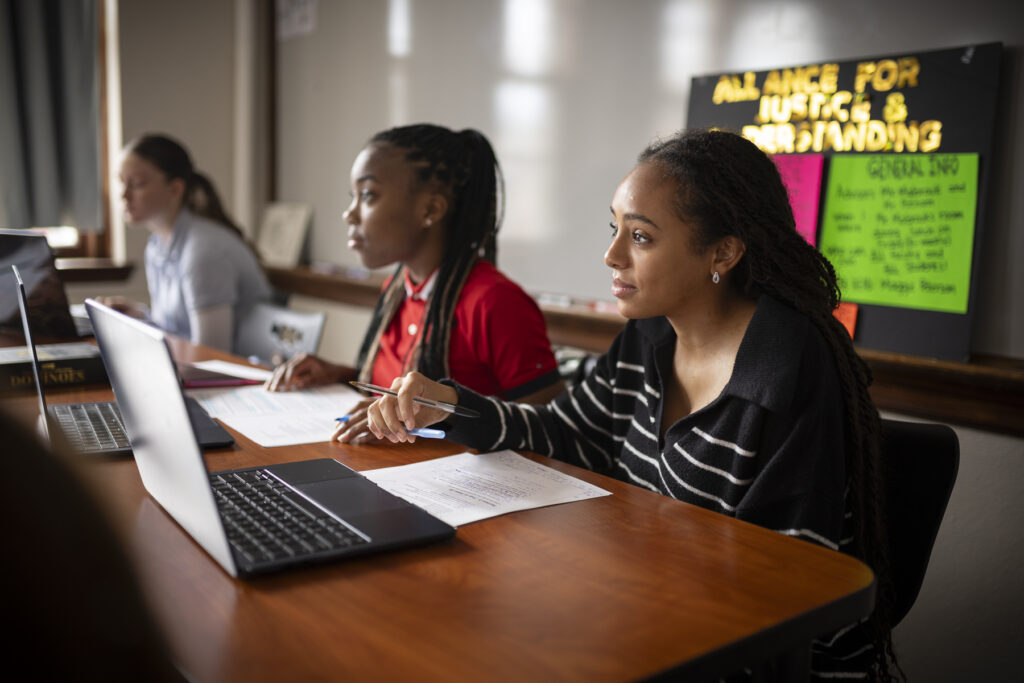

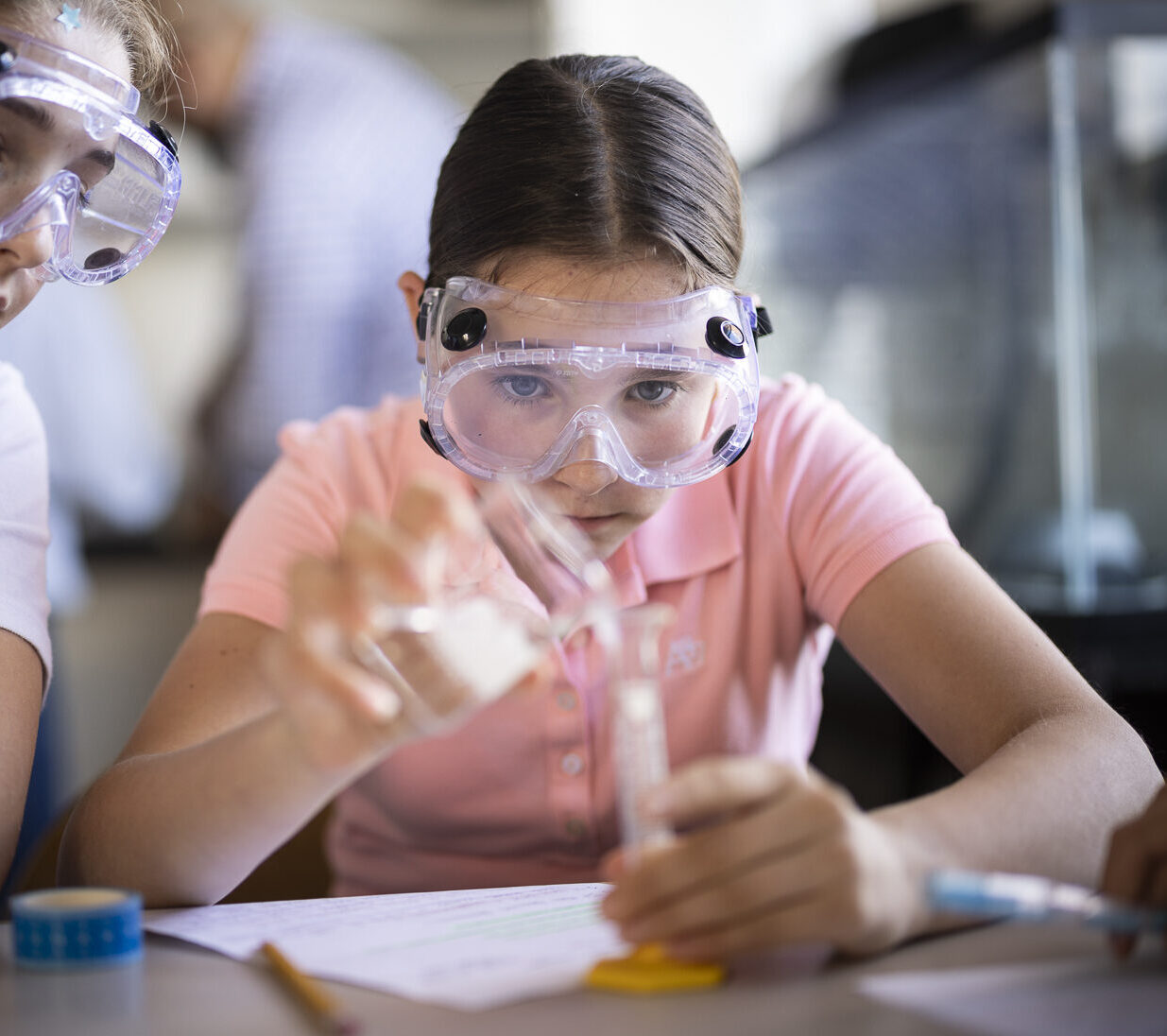
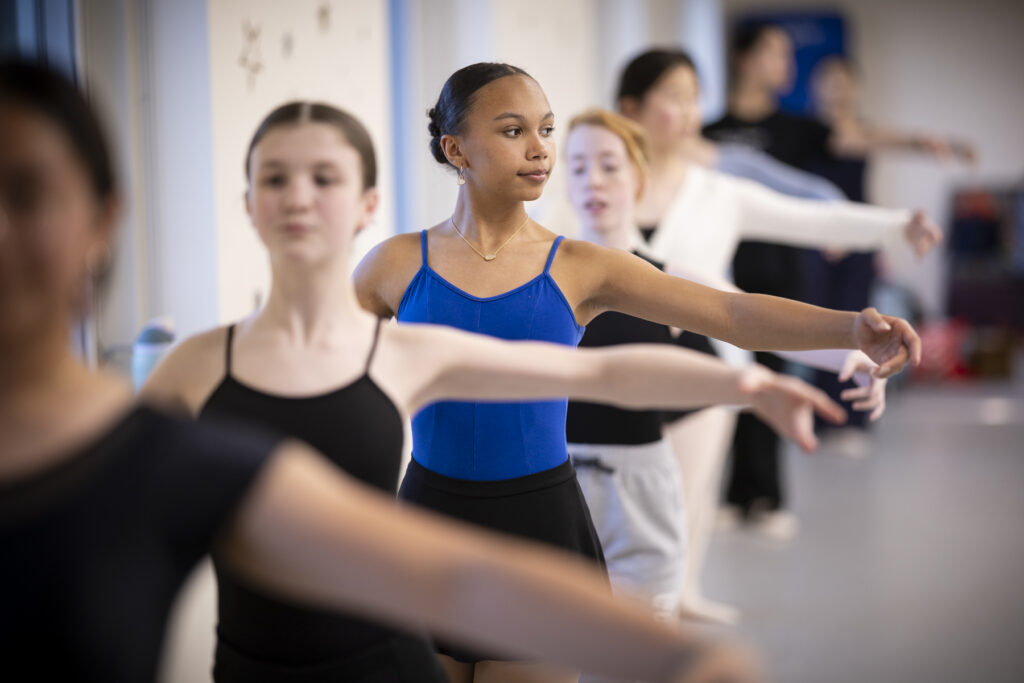
Seminars
The Seminar Program at Walker’s allows students to explore a wide array of topics over the course of their four years in the Upper School. Digital citizenship and public speaking are among the cornerstones of the program as are the development of awareness of the world around us and the empowerment of girls to effect change through the understanding of social justice. In this program, students develop financial literacy, communication, and leadership skills along with heightened level of confidence as they gain new skills and acquire information. Juniors meet regularly with the college counseling office during these class blocks and in the spring semester, seniors are enrolled in a course to learn about what life will be like in college.

Why Wait?
Now offering
middle school
early decision!
Walker’s now offers Early Decision for
Middle School applicants, allowing girls
to spend the winter and spring of their
applying year doing what matters most:
enjoying themselves, finishing out their
current school year well, and mentally
preparing for the transition ahead.
